
The Cursed Poet
The Blessing, Baudelaire, Analysis

Spanish first:
La Bendición
Cuando, por decreto del poder soberano,
el poeta hace su aparición en un mundo fatigado,
con los puños cerrados ante el horror, su madre ultrajada
invoca a un Dios piadoso, contra quien lanza sus maldiciones:
«¿Por qué no fui hecha para parir una nidada de víboras
en vez de concebir esta burla humana?
¡Maldita sea aquella noche de placeres efímeros
que llenó mi vientre de esta traición vengadora!
Ya que debo ser escogida entre todas las mujeres
para cargar con el rencor de por vida de un marido taciturno,
y ya que no puedo deshacerme de esta caricatura
—arrojarla como cartas viejas al fuego—,
sobre lo que has creado para mi castigo
haré recaer todo el odio que me profesas;
torturaré este crecimiento raquítico hasta que sus ramas torcidas
dejen caer al suelo cada brote marchito».
Y así se prepara en
el abismo del infierno un lugar en la hoguera reservada a los crímenes de madre,
ciega, en la furia de su odio espumoso,
al sentido y al fin de los designios eternos.
Mientras tanto, bajo el cuidado de un ángel invisible,
el Niño desheredado se regocija con la fuerza
del sol radiante; todo lo que come y bebe
lo colma de recuerdos del alimento celestial.
El viento es su juguete, toda nube una amiga,
y el Espíritu vigilante sólo puede llorar al ver
cómo, en la infancia, se aligera su vía crucis.
Charles Baudelaire, Las Flores del Mal
Analisis:
Estas son las primeras estrofas de un gran poema del poeta francés Charles Baudelaire. La Bendición es el poema inaugural de Las flores del mal, y por ello es natural interpretarlo como una clave de lectura de los temas que recorrerán los poemas siguientes.
El poeta ocupa un rol divino y profético. Surge de un plan divino: sus dones no son fruto del azar, sino dones de Dios. Dios utiliza la poesía para recordar al mundo la belleza y lo sagrado. El poeta, en este poema, es una bendición: un don de Dios que intenta renovar el mundo.
Este intento divino, sin embargo, se encuentra con la resistencia de un mundo aburrido. La poesía no vale nada para una población que ha perdido su interés en la vida. Vivimos en un mundo de rutina, en el que sólo vale aquello que produce resultados materiales. Existe una presión constante para ganar dinero, para hacer cosas que sostengan el cuerpo, para inventar mecanismos que incrementen la eficiencia. ¿Qué valor tiene la poesía? El mundo no tiene interés en la belleza en sí misma. La poesía no pone pan sobre la mesa. No impulsa el gran progreso técnico de una civilización industrializada.
Por eso, la madre del poeta sufre una profunda vergüenza. Preferiría haber dado a luz víboras antes que esta criatura inútil. Se arrepiente del acto sexual que concibió al poeta. En un impulso de crueldad, la madre preferiría arrojar a su bebé, como si fuera un montón de cartas viejas.
La madre representa las fuerzas técnicas de la sociedad moderna, que marginan la poesía y la consideran algo que sólo puede distraernos de nuestro verdadero propósito. A los ojos crueles de esta sociedad, la poesía parece algo risible. ¿Para qué sirve la poesía? ¿Para qué sirve la filosofía? Siempre debemos justificar nuestras disciplinas. La poesía no resuelve nada, no arregla nada, no construye nada, como sí lo hacen la medicina, la ingeniería, la inteligencia artificial o la informática.
El odio de la madre es intenso y constituye una blasfemia contra Dios, porque Dios ve una carencia en esta sociedad supuestamente avanzada. La poesía puede recordarnos nuestro verdadero destino y las obligaciones que realmente importan. La blasfemia de la madre merece castigo. Ella sólo acepta a su hijo bajo sus propias preferencias y condiciones, pero Dios tiene planes más grandes.
Mientras tanto, a pesar de la rabia materna, el niño poeta disfruta de la protección y el amparo de los ángeles. El poeta desciende de una vida anterior en el cielo, donde se alimentaba del pan celestial. Baudelaire evoca aquí la Eucaristía, el pan del cielo mencionado en el Evangelio de san Juan (Jn 6,31). Como ocurre con todos los profetas, la vocación divina choca con un mundo endurecido. Sin embargo, en la juventud del poeta, la cruz aún no se manifiesta plenamente: disfruta de una infancia luminosa. Pero la vía crucis se aproxima.
Existe un icono famoso de Nuestra Señora del Perpetuo Socorro. En él, la Virgen consuela al niño Jesús, mientras dos ángeles se aproximan portando los instrumentos de la tortura, anticipando la Pasión. En ese momento de su infancia, Jesús está protegido bajo el amparo materno.
De modo semejante, el joven poeta aún conserva una conexión con la vida pacífica del cielo, con su origen trascendente.
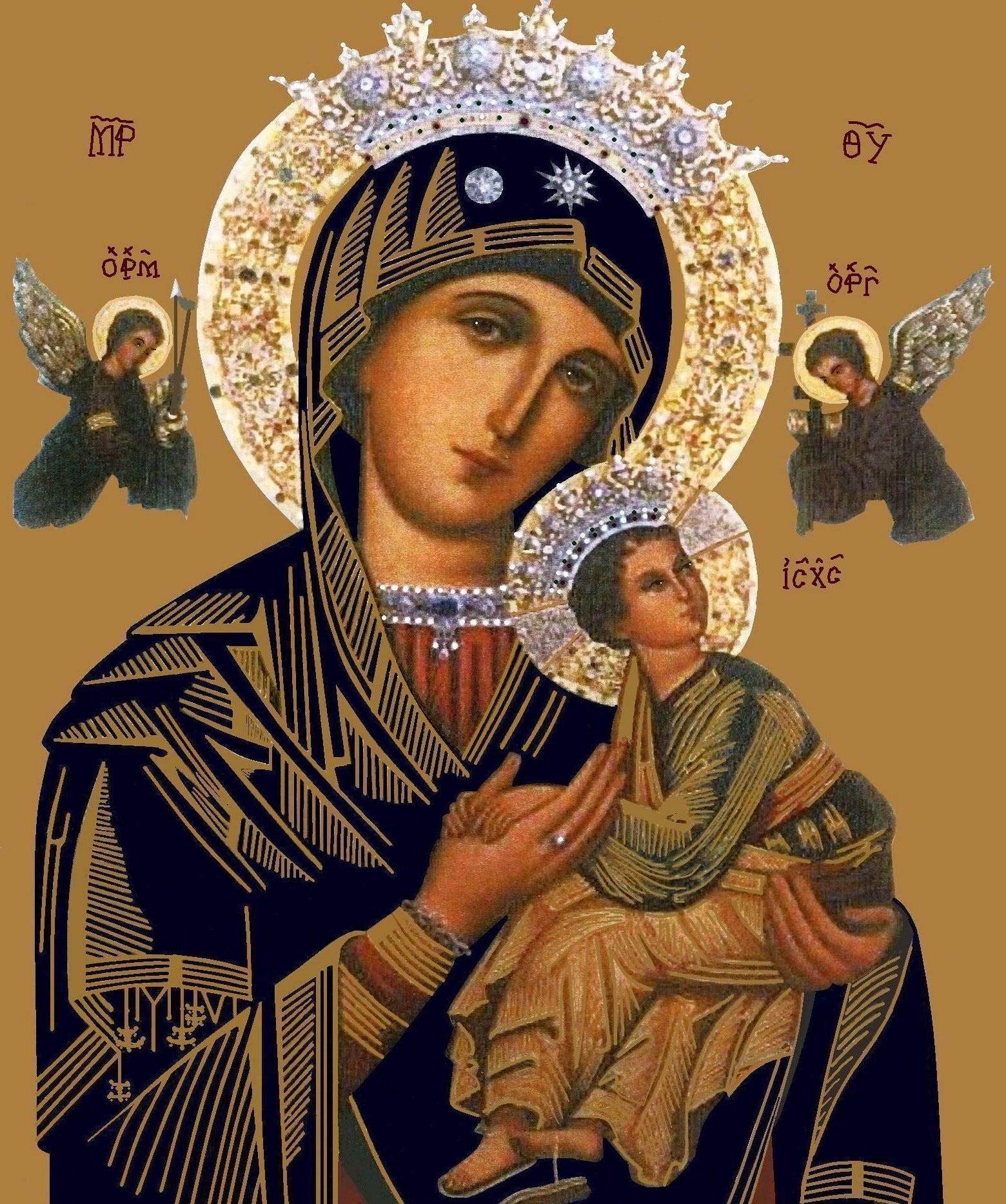
Icon of Our Lady of Perpetual Help, Artist Unknown
English:
The Blessing
When, by a decree of the sovereign power,
The poet makes his appearance in a bored world,
With fists clenched at the horror, his outraged mother
Calls on a pitying God, at whom these curses are hurled:
‘Why was I not made to litter a brood of vipers
Rather than conceive this human mockery?
My curses on that night whose ephemeral pleasures
Filled my womb with this avenging treachery!
Since I must be chosen among all women that are
To bear the lifetime’s grudge of a sullen husband,
And since I cannot get rid of this caricature,
-Fling it away like old letters to be burned,
On what you have devised for my punishment
I will let all your hate of me rebound,
I will torture this stunted growth until its bent
Branches let fall every blighted bud to the ground!’
And so she prepares herself in
Hell’s pit. A place on the pyre made for a mother’s crimes,
Blind, in the fury of her foaming hatred,
To the meaning and purpose of the eternal designs.
Meanwhile, under the care of an unseen angel,
The disinherited Child revels in the sun’s
Bright force; all that he eats and drinks can fill
Him with memories of the food that was heaven’s.
The wind his plaything, any cloud a friend,
The Spirit watching can only weep to see
How in childhood his way of the cross is lightened
Charles Baudelaire, The Flowers of Evil
These are the opening stanzas of a great poem by the French poet Charles Baudelaire. The Blessing is the first poem in The Flowers of Evil, and for that reason it is natural to interpret it as a key to the themes that will occupy the poems that follow.
The poet occupies a divine and prophetic role. He emerges from a divine plan: his gifts are not the result of chance but are gifts from God. God makes use of poetry in order to remind the world of beauty and of the sacred. In this poem, the poet is a blessing—a gift from God that seeks to renew the world.
This divine attempt, however, encounters the resistance of a bored world. Poetry is worth nothing to a population that has lost its interest in life. We live in a world of routine, in which only what produces material results has value. There is constant pressure to make money, to do things that sustain the body, to invent mechanisms that increase efficiency. What is the value of poetry? The world has no interest in beauty as such. Poetry does not put bread on the table. It does not propel the great technical progress of an industrialized civilization.
For this reason, the poet’s mother experiences profound shame. She would have preferred to give birth to vipers rather than to this useless creature. She regrets the sexual act that conceived the poet. In an impulse of cruelty, the mother would rather throw her baby away like a bundle of old letters.
The mother represents the technical forces of modern society, which marginalize poetry and regard it as something that merely distracts us from our true purpose. In the cruel eyes of this society, poetry appears ridiculous. What is poetry good for? What is philosophy good for? We are always required to justify our disciplines. Poetry solves nothing, fixes nothing, builds nothing, unlike medicine, engineering, artificial intelligence, computer science, and so on.
The mother’s hatred is intense, and it constitutes a blasphemy against God. God perceives a lack in this supposedly advanced society. Poetry can remind us of our true destiny and of the obligations that truly matter. The mother’s blasphemy deserves punishment. She accepts her child only according to her own preferences and conditions. But God has greater plans.
Meanwhile, despite the mother’s rage, the child-poet enjoys the protection and shelter of the angels. The poet descends from a prior life in heaven, where he fed on heavenly food. Baudelaire here recalls the Eucharist, the bread from heaven mentioned in the Gospel of Saint John (Jn 6:31). As with all prophets, the divine vocation collides with a hardened world. Yet in the poet’s youth, the cross has not yet fully appeared. He enjoys a pleasant childhood. But the way of the cross is near.
There is a famous icon of Our Lady of Perpetual Help. In this icon, the Virgin comforts the infant Jesus, while two angels stand nearby carrying the instruments of torture that anticipate the Passion. At this moment in his childhood, Jesus is protected under the shelter of his mother.
In a similar way, the young poet still retains a connection to the peaceful life of heaven—his origin.
And this is an excellent piece, Daniel. I appreciate your Spanish translations too.
I remember reading my copy of The Flowers of Evil years ago...a poem that will always stick out to me is the one about the cat.