
Fate or Providence?
Meditation on The House of Spirits

“I suspect that everything that has happened is not accidental, but rather corresponds to a destiny drawn before my birth… It is a rough and crooked stroke, but no brushstroke is useless… Every piece has a reason for being exactly as it is…”
These lines occur in the final pages of The House of the Spirits by Isabel Allende. I highly recommend this novel. It is a multigenerational epic about a family in a Latin American country. The novel intertwines family history with political change. I do not want to reveal too many details of the plot. However, I want to focus on the philosophical idea of a determined destiny.
The plot is filled with tragedies. And toward the end, the narrator contemplates taking revenge on those who harmed her. Yet she rejects revenge. The painful events in the book form a mysterious symmetry. The tragedies that seem to deserve vengeance are links in a chain of events that ultimately acquires a profound meaning. Even evil things play a role in the chain of events that finally leads to a good outcome. The narrator renounces revenge because even the wrongdoers are necessary for the positive unfolding of events. The generations, with all the events that break hearts in their own moment, form a great picture. It is not so beautiful in its small details, but when we consider the whole picture, everything makes sense.
The plot of Allende’s novel is very powerful. In its smaller details, it appears episodic. It is a chaos of details involving many people in a large family. But when we consider the events from a distance, they no longer form a chaos. We see the causal connections between the various circumstances. We say: without this, that would not have been possible…
Many times I have heard the phrase: everything happens for a reason. That is to say, nothing happens without a greater purpose. No event happens simply by chance.
It is an optimistic vision of life. I have also heard the idea of a meaningless death. For example, a person dies very young, robbed of a full life. By contrast, a death after ninety years has meaning, or at least seems acceptable.
This vision has a biblical basis, but with a crucial qualification. In Romans 8:28, Paul the Apostle says: “And we know that for those who love God all things work together for good, for those who are called according to his purpose.” In this verse, we find the idea that all circumstances cooperate for the good, even difficult things. God permits evil in order to produce a greater good. In Allende’s novel, there are rapes and torture. Yet the narrator experiences a sense of peace because the fragments of her family’s history possess meaning when taken together as a whole.
However, Paul implies a crucial exception to this happy ending in which everything makes sense. Circumstances cooperate for the good for those who love God. If we love God, if we possess a good will, if we are attempting to do good in the world, we are not invulnerable to evil, but evil ultimately generates a greater good. But if we do not love God, we open ourselves to chaos. Things do not cooperate for the good if we do not love God. There can be tragic things that have no meaning if we lack a fundamental orientation of love toward God.
This qualification from Paul provides a basis for criticizing the narrator’s vision in the final pages of The House of the Spirits. It is important to recognize that a narrator—that is, a character in the novel—writes these lines about destiny. They are not necessarily Allende’s own beliefs. The lines about destiny perhaps represent the fallible ideas of a character.
These lines lack Paul’s qualification. It is possible that all events possess meaning for any person, whether good or evil. There is a predetermined destiny encompassing every person. There is an inevitable fate whose logic affects everyone alike. It does not depend upon a good will or one’s orientation toward God.
This vision of a fate indifferent to the distinction between good and evil can serve as a justification of evil and a complacency in the presence of evil. If there is a fixed fate, there is no need to change, repent, or struggle against evil. Destiny cannot be avoided, and therefore it is useless to worry about circumstances.
Paul’s statement allows space for our free will. Through our capacity for free choice, we can alter the course of events. If we love God, we will not avoid evil, but the evil that occurs will possess meaning. But if we do not love God, the evil that occurs will not possess meaning. There is destiny and providence, but this does not remove our responsibility for ourselves.
There is a story in the Book of Genesis (Genesis 37–50) that also contains the message of a mysterious destiny, as though an invisible hand were guiding events. It is the story of Joseph. In summary, Joseph’s brothers sold him into slavery. Joseph went to Egypt, where his ability to interpret dreams was discovered. Joseph eventually becomes a leader in Egypt. A famine strikes the land, and Joseph, as a political leader, is able to help his brothers. It is as though the evil act of the brothers had been necessary. Joseph would never have arrived in Egypt without this evil deed.
But is fate something indifferent, or is fate dependent upon our disposition? I believe that if Joseph had not been a good man, his life would not have possessed a coherent arc. We can introduce chaos into our lives through a disposition indifferent toward God. If we do not seek God, we become vulnerable to total disorder. When we consider our lives, they appear to be a tangle of chance and accident.
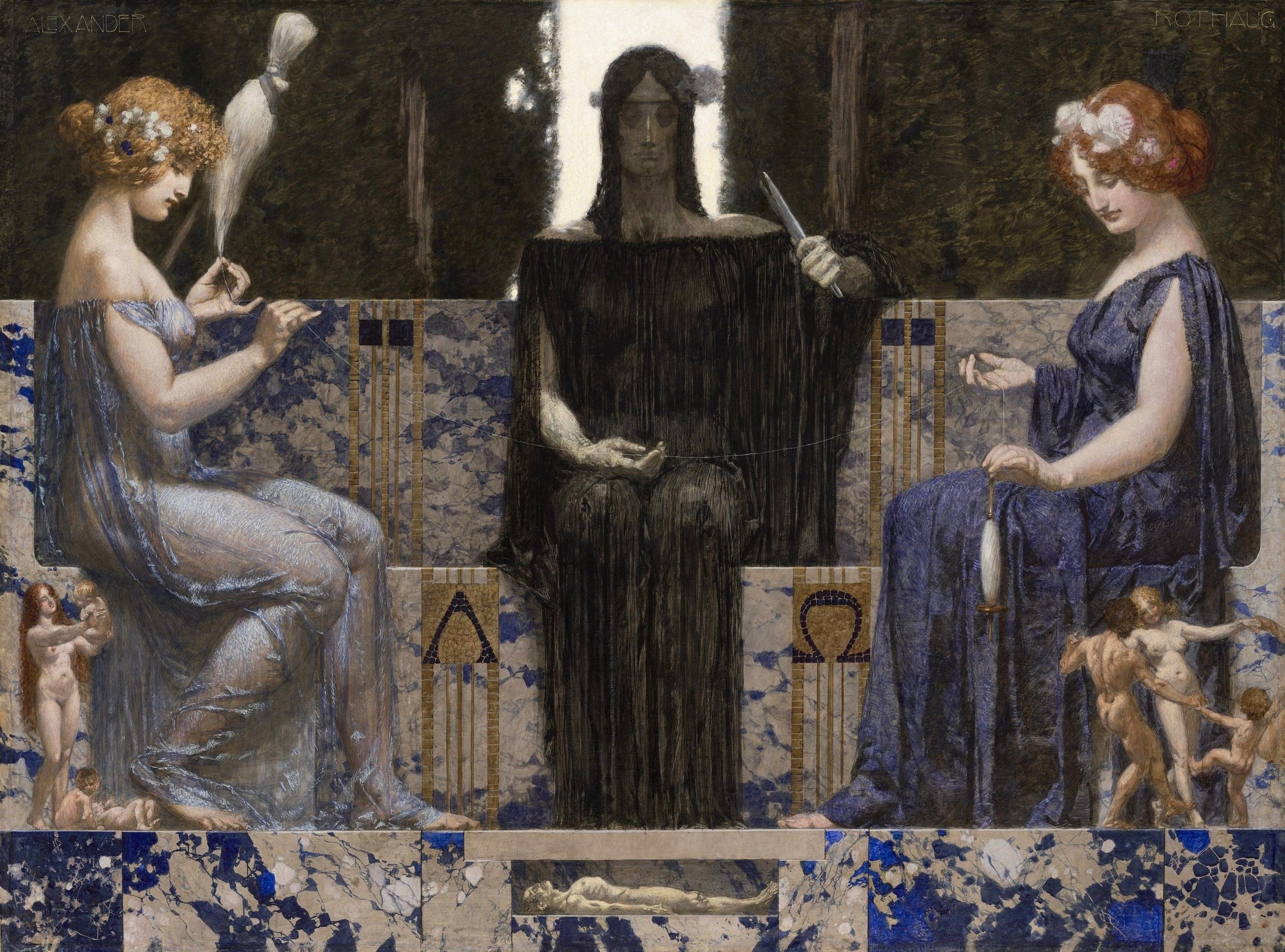
The Three Fates, Alexander Routhag
Reminds me of the prayer of St. Thomas More: "Give me the grace, Good Lord, to think my worst enemies my best friends, for the brethren of Joseph could never have done him so much good with their love and favor as they did him with their malice and hatred."
Yes. This is a great wisdom that the Bible teaches us: that sometimes evil people can be used to bring about good ends. Evil people are always people who do not see the whole picture. Usually they only see one aspect of reality: their own advantage. That is precisely why they are so easily used. But also why they tend to use others.